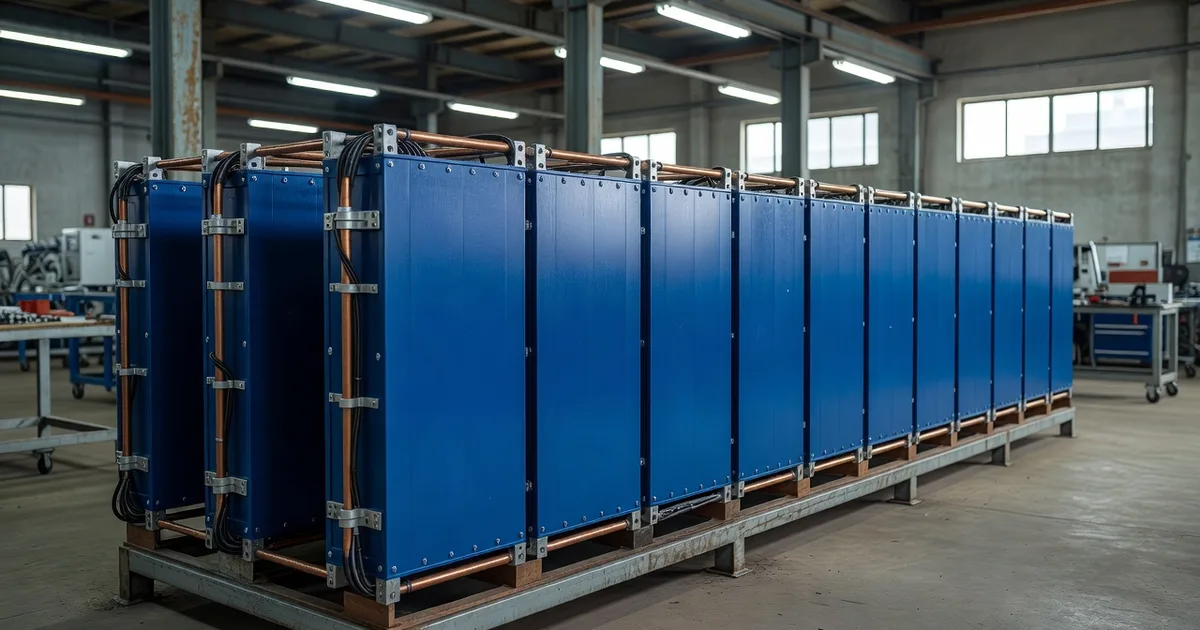
The short answer: lithium iron phosphate uses no nickel and no cobalt. It stores less energy per kilogram than nickel chemistries, so the pack is heavier for the same range, but it survives more charge cycles, costs less per kWh, tolerates a daily 100% charge, and needs a much higher temperature before it will run away thermally. It is the least glamorous chemistry on this page and, for most drivers, the most sensible one.
Key figures
| Cathode | LiFePO₄ — lithium, iron, phosphate. No nickel, no cobalt. |
|---|---|
| Cell energy density | Roughly 90–160 Wh/kg in ordinary production cells; CATL has claimed 205 Wh/kg at cell level for its best LFP. |
| Cycle life | Commonly quoted at 2,000–5,000 full cycles. Some manufacturers claim 6,000–10,000 under laboratory conditions. Sources disagree by a factor of three — see the caveat below. |
| Thermal runaway onset | About 220–260 °C at cell level, versus roughly 170–210 °C for NMC. Peak cell-face temperature in runaway around 620 °C, against about 800 °C for NMC. |
| Nominal cell voltage | 3.2 V — lower than the 3.6–3.7 V of nickel chemistries, so an LFP pack needs more cells in series for the same voltage. |
| Pack price, 2025 | About $81/kWh, against roughly $128/kWh for NMC, in BloombergNEF’s survey. |
Figures as published by the sources credited at the foot of this page. Where sources disagree, both numbers are shown rather than averaged.
Why it behaves the way it does
The olivine crystal structure of lithium iron phosphate holds its oxygen tightly. Nickel-rich cathodes do not: heat them enough and they release oxygen inside a cell that is already full of flammable electrolyte, which is the mechanism behind a battery fire that feeds itself. LFP does not have a comparable oxygen-release reaction at the same temperatures, which is why every published comparison puts its runaway onset a good 50 °C higher and its peak temperature lower.
The same structural stability is why LFP cycles so well. Charging and discharging a cell physically strains the cathode lattice; LFP’s changes shape less, so it degrades more slowly. That is the honest engineering reason behind the cycle-life claims, and it is also why the chemistry is now dominant in stationary storage, where cycle count matters far more than weight.
The costs of that stability are two. Iron phosphate stores less lithium per unit mass than a nickel-rich cathode, so you carry more kilograms per kWh. And LFP has a famously flat discharge voltage curve — the voltage barely changes across most of the state of charge — which makes it genuinely hard for a battery management system to work out how full the pack is.
What it means if you own one
Charge it to 100%, and do it regularly
This is the single piece of advice that inverts for LFP. Manufacturers using it tell owners to charge to 100% rather than the 80% ceiling recommended for nickel packs — and not merely because it is harmless. That flat voltage curve means the battery management system loses track of true state of charge over time, and a full charge is what recalibrates it. An LFP car left permanently at 70% will start reporting range badly.
Cold weather costs you more
LFP’s internal resistance rises more sharply as temperature falls. In practice that means a bigger winter range penalty and noticeably slower DC charging until the pack is warmed. If you live somewhere with real winters and rely on public rapid charging, this is the chemistry’s weakest point and it is worth weighing against the cost saving.
You are carrying more weight
For a given usable capacity, an LFP pack is heavier. That shows up as slightly worse efficiency and, in smaller cars, as a real packaging constraint. It is why long-range flagships still tend to use nickel chemistries, and why LFP first took hold in standard-range trims.
Where the cycle-life numbers come from, and why to distrust them
You will see LFP cycle life quoted as 2,000, as 5,000, and as 10,000, sometimes on the same page. These are not all describing the same test. A cycle count depends on the depth of discharge, the charge rate, the temperature, and — crucially — on what counts as end of life, which is usually 80% of original capacity but is sometimes 70%. A cell cycled gently at 25 °C between 20% and 80% will produce a far larger number than the same cell cycled hard from empty to full at 40 °C.
None of these laboratory figures translate directly into years of service in a car, because a car spends most of its life sitting still, at whatever temperature and state of charge you left it at. Calendar ageing, not cycle count, is what limits most private cars. We publish cycle-life numbers here because they are the industry’s own comparison, not because they predict how long your pack will last.
Cars in our database using LFP
- BYD Seal AWD Excellence — BYD’s Blade pack, a cell-to-body LFP design
LFP is far more common than that one entry suggests; it simply concentrates in standard-range trims and in the Chinese market, and our first ten cars lean towards long-range versions. Note also that chemistry varies by market and by build plant for the same model name — the figure on each of our vehicle pages describes the specific version we sourced, not every car sold under that badge. Compare any two of them side by side in the comparison tool.
Frequently asked questions
Is LFP safer than NMC?
On the measurable criteria, yes. Published cell testing puts LFP’s thermal runaway onset roughly 50 °C higher, its peak temperature around 180 °C lower, and its propagation between cells several times slower. That does not make an LFP car safe and an NMC car dangerous — a modern nickel pack with active liquid cooling and a well-designed enclosure is engineered around exactly this problem. It means the chemistry gives the engineers more margin to work with.
Should I buy LFP or nickel?
If you charge at home, drive typical distances, and want the pack to still be healthy in ten years, LFP is the better fit and usually the cheaper car. If you need maximum range from minimum weight, or you rely on rapid charging in a cold climate, a nickel chemistry will serve you better. The decision is about your charging pattern, not about which chemistry is superior.
Why is my LFP car’s range estimate so inaccurate?
Almost always the flat voltage curve, and almost always fixable. Charge to 100% and leave it there briefly so the battery management system can recalibrate. If the car has been kept in a narrow charge band for months, expect the estimate to be poor until you do this.
Does LFP lose less capacity over time?
Cycle testing says yes, clearly. Fleet data on real cars is a different question, and there is not yet a published, model-by-model dataset large enough to separate chemistry from every other variable — climate, charging habits, and vehicle age all move the number. We treat the laboratory advantage as well established and the real-world size of it as not yet measured. See our degradation analysis for what the fleet data does and does not show.
Sources
- BloombergNEF, 2025 Lithium-Ion Battery Price Survey — pack prices by chemistry; global average $108/kWh, LFP about $81/kWh
- Thermal runaway propagation in automotive lithium-ion batteries with NMC-811 and LFP cathodes — comparative onset temperature and propagation rate
- ACS Chemical Health & Safety, thermal runaway of cylindrical lithium-ion cells: a review — onset temperatures and self-heat rates by cathode
- Lithium iron phosphate battery — specific energy figures, including CATL’s 205 Wh/kg cell-level claim
- EV Database — per-model chemistry and pack configuration cited on each vehicle page