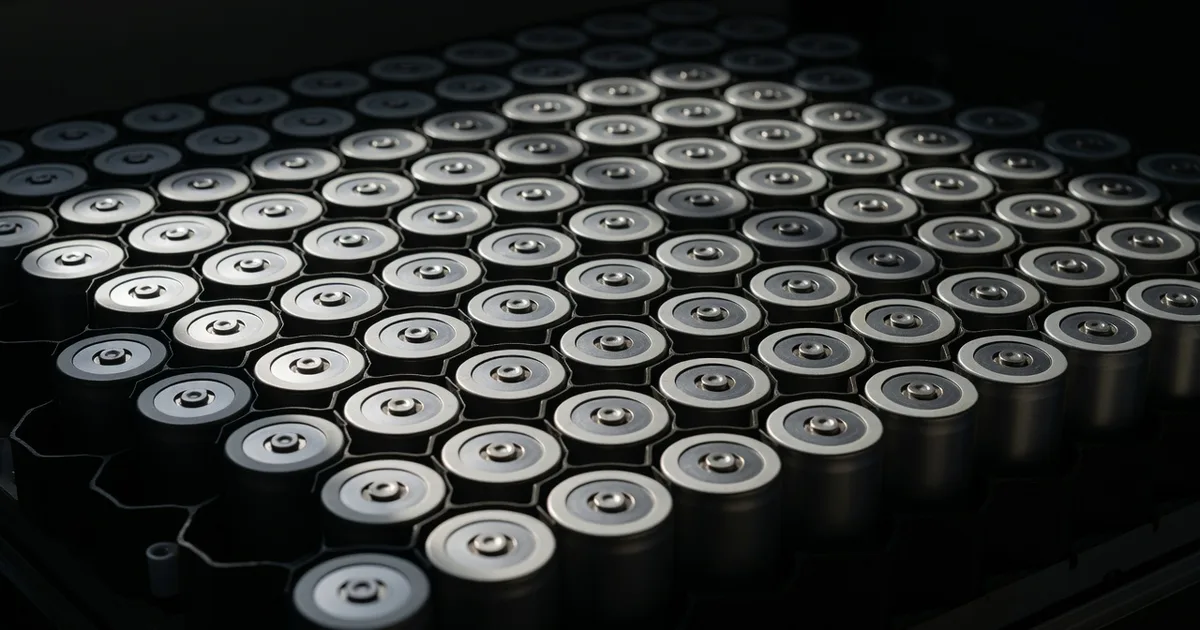
The short answer: nickel cobalt aluminium is the other nickel-rich cathode. It behaves much like NMC from an owner’s point of view — charge to 80% daily, keep it cool — but it has historically been Panasonic’s and Tesla’s chemistry rather than the broader industry’s. If you own a US-built Tesla, there is a good chance this is what is under the floor, even when the same model built elsewhere uses NMC.
Key figures
| Cathode | Lithium nickel cobalt aluminium oxide. Aluminium replaces manganese as the structural stabiliser. |
|---|---|
| Energy density | At the top of the nickel-rich range — the reason it was chosen for maximum-range cars. |
| Thermal behaviour | Comparable to NMC in onset temperature, with the highest maximum self-heat rate recorded in the cylindrical-cell review cited below. |
| Typical format | Cylindrical. The 2170 cell (21 mm × 70 mm) is the volume workhorse; the 4680 (46 mm × 80 mm) was announced by Tesla in September 2020. |
| Main supplier | Panasonic, notably at Gigafactory Nevada, supplying Tesla. |
Why this chemistry is confusing to shop for
NCA is the clearest example of a problem that runs through this whole site: the same car, with the same name and the same trim, can ship with different cells depending on where it was built. A Model Y assembled in Nevada or Austin is likely to carry Panasonic NCA 2170 cells. The same Model Y assembled in Berlin or Shanghai may carry LG NMC cells or, in standard-range trims, LFP.
That is why our Model Y page records NMC: the specification we sourced is the European Long Range AWD with LG cylindrical cells, and the source and date are printed next to the figure. It is not an error, and it is not a claim about every Model Y. Any site that gives you one chemistry per model name is either simplifying or guessing.
If chemistry matters to your decision, the reliable way to find out is the vehicle’s own documentation or a VIN-level lookup for the specific car you are buying — not a specification table, ours included.
Aluminium instead of manganese
Both NMC and NCA solve the same problem: nickel gives you energy density but makes the cathode structurally and thermally fragile, so something has to stabilise it. NMC uses manganese and cobalt. NCA uses aluminium and cobalt. Aluminium is light, cheap and effective at suppressing the structural changes that degrade a cathode over cycles, which is how NCA reaches the energy densities it does without collapsing.
The trade-off shows up in thermal testing. The cylindrical-cell review cited below records the highest maximum self-heat rate of any cathode tested for a 21700 NCA cell — meaning that once a runaway starts, this chemistry releases its energy fast. As with NMC, the practical answer is engineering: cell spacing, venting, and above all active liquid cooling.
What it means if you own one
In daily use, treat an NCA car exactly as you would an NMC one. Charge to around 80% for routine driving and go to 100% only before a long trip. Avoid leaving the car sitting at a high state of charge in hot weather, which is the combination that ages nickel cathodes fastest. Precondition the pack before rapid charging in winter.
The one genuinely distinct consideration is the cylindrical format. Thousands of small cells give a pack designer good thermal contact area and a natural firebreak between cells, but they also mean thousands of connections. This is an engineering trade-off rather than an ownership one — there is nothing a driver does differently because of it.
Frequently asked questions
How do I find out whether my car has NCA or NMC?
Build location is the strongest clue for Teslas — Nevada and Austin lean Panasonic NCA, Berlin and Shanghai lean LG NMC or LFP — but it is not a rule you should rely on for a purchase decision. The reliable answers are the vehicle’s own service documentation or a VIN-level lookup. A specification table cannot tell you this with certainty, and any that claims to is overstating what it knows.
Is NCA better than NMC?
Not in any way that changes a buying decision. NCA has historically edged ahead on energy density; NMC has the broader supply base and more chemistry variants. Both need the same care from an owner and both depend on the same thing for safety — how well the pack is cooled.
What is the 4680 cell, and does it change the chemistry?
The 4680 is a format, not a chemistry — a 46 mm by 80 mm cylindrical cell that Tesla proposed in September 2020, considerably larger than the 2170 it succeeds. A larger cell means fewer connections and a simpler pack, but also more heat generated inside a single can, which is a harder cooling problem. Cells of either size can use various nickel-rich cathodes.
Does NCA use more cobalt than NMC?
Not necessarily. Both families have been reducing cobalt content over successive generations for cost and supply-chain reasons, and the ratios differ between specific formulations rather than between the two families as a whole. Comparing a named formulation to another named formulation is meaningful; comparing “NCA” to “NMC” on cobalt content is not.
Sources
- ACS Chemical Health & Safety, thermal runaway of cylindrical lithium-ion cells: a review — self-heat rates and onset temperatures for 21700 NCA, NMC and 18650 LFP cells
- Recurrent — what kind of battery is in my Tesla — chemistry by build location and trim
- EV Database — Tesla Model Y Long Range AWD — the specific European configuration our vehicle page describes