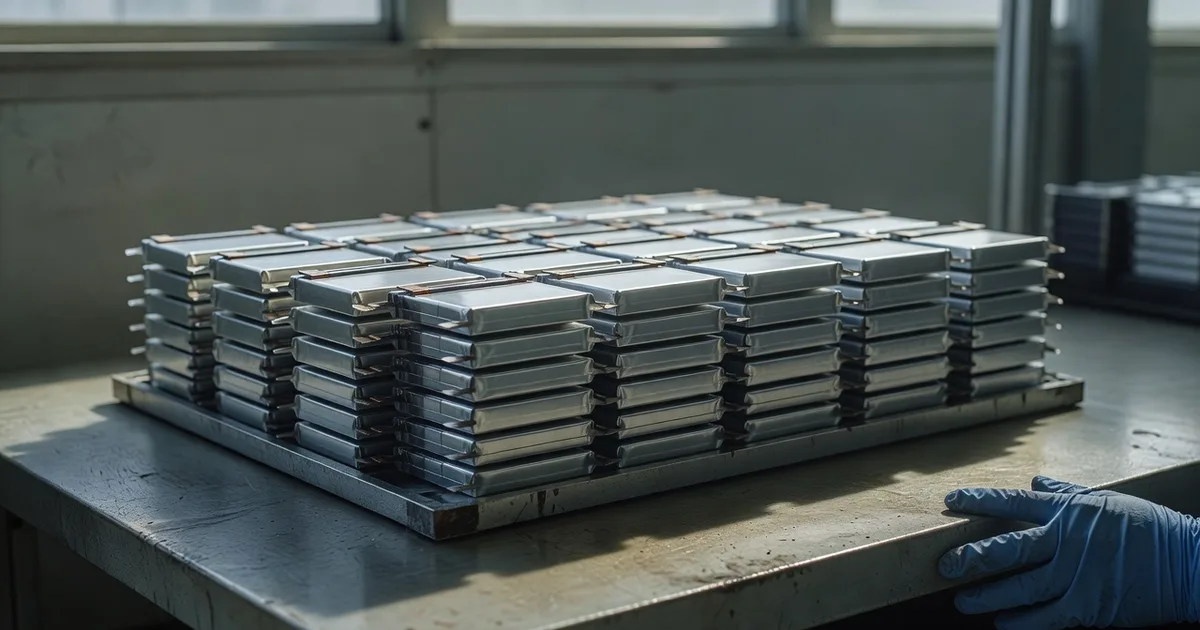
The short answer: nickel manganese cobalt is the default chemistry for long-range electric cars, and nine of the ten vehicles in our database use it. It stores substantially more energy per kilogram than LFP, which is the whole reason it exists. In exchange it costs more, cycles fewer times, and needs a properly engineered cooling system because it becomes unstable at a lower temperature.
Key figures
| Cathode | Lithium nickel manganese cobalt oxide. The three metals are blended in ratios written as 111, 622, 811 and so on. |
|---|---|
| Cell energy density | Roughly 150–250 Wh/kg in production cells; the best reported cells exceed 300 Wh/kg. |
| Cycle life | Commonly quoted at 1,000–2,000 full cycles, with some sources citing 3,000–5,000. As with LFP, the number depends entirely on test conditions. |
| Thermal runaway onset | About 170–210 °C at cell level. Peak cell-face temperature in runaway around 800 °C. NMC-811 propagates between cells roughly nine times faster than LFP. |
| Nominal cell voltage | 3.6–3.7 V |
| Pack price, 2025 | About $128/kWh, against roughly $81/kWh for LFP, in BloombergNEF’s survey. |
What the numbers in the name mean
NMC 811 means a cathode that is 8 parts nickel, 1 manganese, 1 cobalt. NMC 622 is 6:2:2. The trend across the industry has been to push the nickel fraction up, because nickel is what carries the energy density, and to push cobalt down, because cobalt is the most expensive and the most ethically fraught input in the cell.
That trend has a cost, and it is the reason this page spends so long on thermal behaviour. Cobalt and manganese are structural stabilisers. Strip them out to chase range and the cathode becomes more reactive: higher nickel content correlates with a lower thermal runaway onset and a faster, hotter event when one starts. A modern NMC 811 pack is not unsafe — it is engineered around a harder problem than an NMC 622 pack was.
Why cooling design matters more here
Every comparison we have looked at puts NMC’s runaway onset roughly 50 °C below LFP’s, its peak temperature around 180 °C higher, and its cell-to-cell propagation several times faster. That is not an argument against buying a nickel-chemistry car. It is an argument for looking at how the pack is cooled before you buy one.
This is why our vehicle pages record thermal management as a separate field, and why it carries weight in the battery safety score we compute. A pack with liquid cooling plates in direct contact with the cells, or refrigerant cooling, has a genuine engineering answer to the chemistry’s weakness. A pack relying on forced air, or worse on passive air, does not. The chemistry is only half the safety question; the cooling architecture is the other half. Our methodology page sets out exactly how that score is calculated and what it does not cover.
What it means if you own one
Daily charge to 80%, not 100%
Nickel chemistries age faster when held at a high state of charge, and the effect compounds with heat. The standard manufacturer advice — charge to around 80% for daily use, go to 100% only before a long trip and drive soon after — exists for real chemical reasons and is worth following. This is the opposite of the advice for LFP.
Cold performance is better than LFP’s
Internal resistance still rises in the cold and you will still lose range, but less severely, and DC charging recovers faster once the pack is preconditioned. In a genuinely cold climate this is the strongest practical argument for a nickel pack.
The weight advantage is real
At the same usable capacity a nickel pack is lighter, which improves efficiency, handling and packaging. Compounded over a large pack this is why every long-range flagship in our database uses one.
Cars in our database using NMC
- Tesla Model Y Long Range AWD — LG cylindrical cells in the version we sourced
- Hyundai Ioniq 6 Long Range RWD
- Porsche Taycan (rear-wheel drive)
- Kia EV9 99.8 kWh AWD
- Volkswagen ID.7 Pro
- BMW i4 eDrive40
- Volvo EX30 Single Motor Extended Range
- Ford Mustang Mach-E Extended Range RWD
- Rivian R1T Dual Motor, Large pack
An important caveat on all of these. Cell chemistry varies by market, by build plant and by model year for the same car. A Model Y assembled in Nevada may carry Panasonic NCA cells while one assembled in Berlin carries LG NMC. Each figure on our vehicle pages describes the specific version we sourced, with the source and date shown next to it — not every car sold under that name.
Frequently asked questions
Is NMC dangerous?
No. It is less thermally forgiving than LFP, which is a different statement. Millions of NMC cars are on the road, and the packs are designed with cooling, cell spacing, venting and enclosure structure specifically to manage that. What the chemistry does mean is that the quality of the pack engineering matters more than it does with LFP — which is why it is worth checking how a car cools its battery rather than only what chemistry is inside it.
What is the difference between NMC and NCA?
Both are nickel-rich cathodes. NMC uses manganese and cobalt as the secondary metals; NCA uses cobalt and aluminium. NCA typically pushes energy density slightly higher and has historically been Panasonic’s and Tesla’s choice; NMC is the broader industry standard. In practical ownership terms they behave similarly — charge to 80% daily, keep them cool.
Does NMC 811 degrade faster than NMC 622?
Higher nickel content is generally associated with faster capacity fade and more thermal sensitivity, and that is the accepted direction of the trade-off. Putting a number on it for a specific car is not currently possible from public data — manufacturers do not publish per-pack degradation curves, and the fleet studies that exist do not break results down by cathode ratio.
Will NMC be replaced by LFP?
Partly, and it is already happening at the affordable end — the shift towards LFP is one of the forces BloombergNEF credits for falling pack prices. But nickel chemistries still win decisively on energy per kilogram, and that matters most in exactly the cars people pay most for. The likeliest outcome is not replacement but segmentation: LFP and sodium-ion at the affordable and cold-climate end, nickel at the long-range end.
Sources
- BloombergNEF, 2025 Lithium-Ion Battery Price Survey — pack prices by chemistry and the LFP shift
- Thermal runaway propagation in automotive lithium-ion batteries with NMC-811 and LFP cathodes — propagation speed and system integration requirements
- ACS Chemical Health & Safety, thermal runaway of cylindrical lithium-ion cells: a review — onset temperatures and self-heat rates by cathode
- EV Database — per-model chemistry, cell supplier and pack configuration cited on each vehicle page