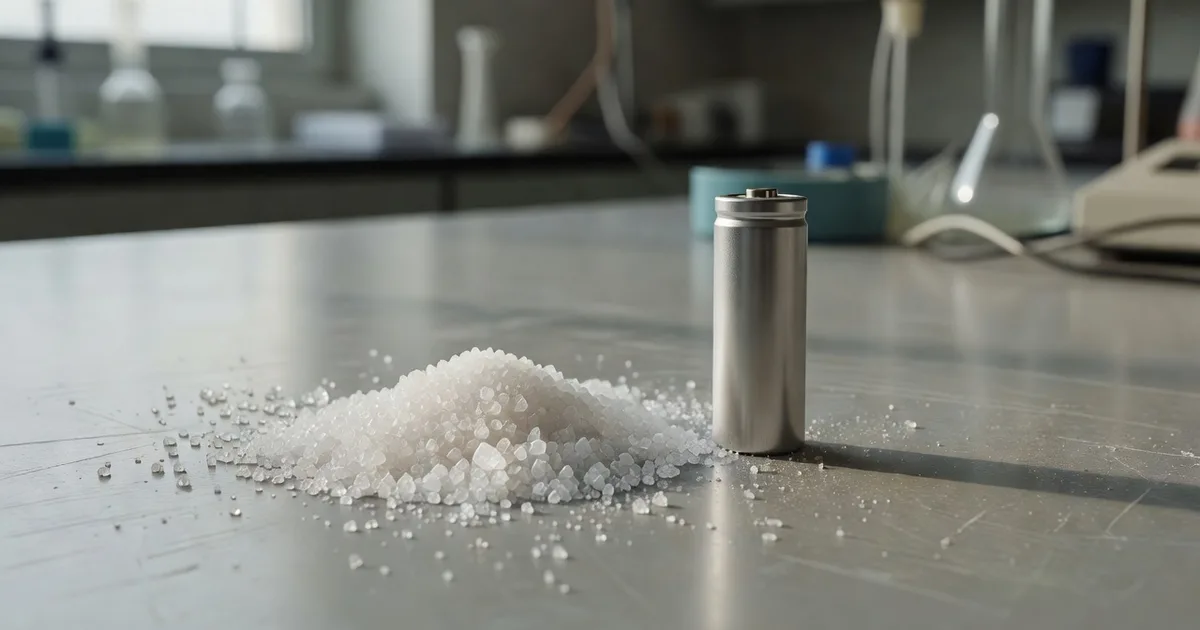
The short answer: sodium-ion is the one emerging chemistry that actually reached customers in 2026. CATL’s Naxtra cell reaches up to 175 Wh/kg, and CHANGAN unveiled the first mass-production sodium-ion passenger car in February 2026 for a mid-2026 launch. It stores less energy per kilogram than LFP, so it will not power long-range flagships — but it is extraordinary in the cold, which is precisely where lithium chemistries are weakest.
Key figures
| Cell energy density | Up to 175 Wh/kg for CATL’s Naxtra, the current mass-production benchmark. Below LFP’s best, well below nickel chemistries. |
|---|---|
| Cold retention | Retains more than 90% of capacity at −40 °C. Delivers stable power down to −50 °C. |
| Cold power | Nearly three times the discharge power of an equivalent LFP cell at −30 °C. |
| Range achieved | Over 400 km in the CHANGAN vehicle using cell-to-pack construction. CATL projects 500–600 km as the supply chain matures. |
| Key input | Sodium. Abundant and geographically unconstrained, unlike lithium, nickel and cobalt. |
| Availability | In production. CATL confirmed large-scale 2026 deployment across passenger cars, commercial vehicles, battery swapping and stationary storage. |
The cold-weather case
Every other chemistry on this site gets worse in winter, and the mechanism is the same in each: as temperature falls, internal resistance rises, so the pack delivers less power, accepts charge more slowly and gives up range. LFP suffers this worst. It is the single strongest practical argument against buying an LFP car in a cold climate.
Sodium-ion largely does not have this problem. Retaining over 90% of capacity at −40 °C is not an incremental improvement over lithium chemistries; it is a different order of behaviour. Nearly three times the discharge power of LFP at −30 °C means the difference between a car that struggles and one that simply works.
This is why the sensible way to think about sodium-ion is not as a replacement for lithium but as the right answer to a specific set of problems: affordable compact cars, battery-swapping fleets, commercial vehicles working outdoors in winter, and stationary storage where weight is irrelevant.
What it gives up
Energy density, and there is no way around it. A sodium ion is larger and heavier than a lithium ion, so a sodium cell stores less energy in the same mass. At up to 175 Wh/kg, Naxtra sits below the best LFP and far below nickel chemistries that exceed 300 Wh/kg at cell level. For a given range, a sodium-ion car carries more battery weight than any lithium alternative.
Cell-to-pack construction claws some of this back by removing module structure and using the pack itself as a stiffener, which is how the CHANGAN vehicle exceeds 400 km. But the underlying chemistry sets a ceiling, and it is a lower one.
The other honest caveat is that this is a young technology in cars. Long-term degradation behaviour in a passenger vehicle over ten years is not yet observable, because no sodium-ion car has been on the road for ten years. Cycle-life claims exist; road evidence does not.
Why abundance matters
Sodium’s advantage over lithium is not chemical performance; it is supply. Lithium, nickel and cobalt are concentrated in a small number of countries and their prices move sharply on supply news — BloombergNEF attributed part of 2025’s rise in battery metal costs to supply risks at Chinese lithium assets and to new cobalt export quotas in the Democratic Republic of Congo. Sodium is not scarce anywhere.
That is a strategic argument rather than a driver’s one. It matters for whether affordable EVs stay affordable through the next commodity cycle, which eventually reaches the showroom — but it will not show up in any figure on a specification sheet.
Frequently asked questions
Can I buy a sodium-ion car?
In China, yes — CHANGAN’s sodium-ion passenger vehicle was unveiled in February 2026 for a mid-2026 launch, and CATL has confirmed large-scale deployment across several vehicle categories during 2026. Availability in Europe and North America is a separate question of homologation and importing, and is not something we can confirm for any specific market today.
Is sodium-ion going to replace lithium?
No, and the companies building it do not claim so. Its energy density rules it out of long-range vehicles. The realistic outcome is segmentation — sodium-ion in affordable compacts, swapping fleets, commercial vehicles and cold-climate use, LFP in the mainstream, nickel chemistries at the long-range end.
Is it safer than lithium-ion?
Sodium-ion cells are generally described as thermally more tolerant than nickel chemistries, and they can be discharged to zero volts for transport, which lithium cells cannot. We are not publishing a comparative runaway onset temperature here because we have not found testing on sodium cells equivalent to the cylindrical-cell studies we cite for the lithium chemistries. Where we do not have the measurement, we say so rather than estimating.
How does it compare with solid-state?
They are opposites in every respect that matters. Solid-state promises much higher energy density and is not yet in any customer car. Sodium-ion promises lower energy density and is in production now. If you want to know which emerging chemistry will affect what you can actually buy this year, it is this one.
Sources
- CATL — CATL and CHANGAN launch the world’s first mass-production sodium-ion passenger vehicle — Naxtra energy density, cold-weather figures and range
- CarNewsChina — CATL confirms 2026 large-scale sodium-ion deployment — sectors and rollout scope
- BloombergNEF, 2025 Lithium-Ion Battery Price Survey — battery metal price pressure and its causes