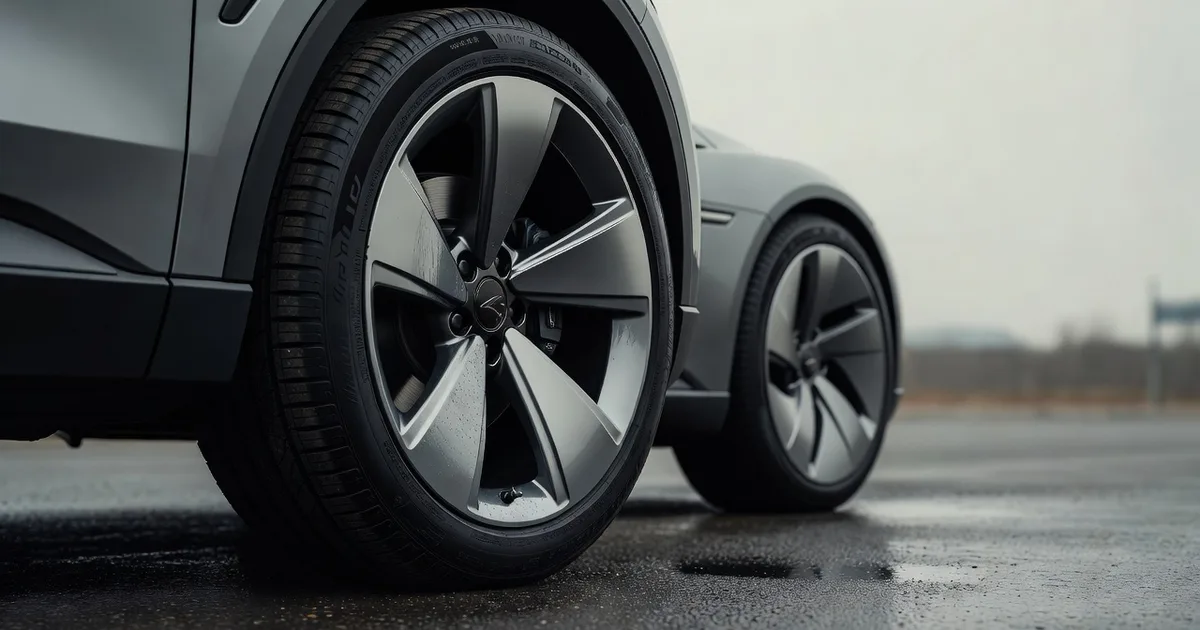
The EPA certifies wheel and tyre packages separately, and the gap between them on the same car reaches 48 miles. The BMW i5 eDrive40 Sedan is rated 328 miles on 19-inch wheels and 280 on 21-inch — same battery, same year, one box on the order form. 63 model families are certified more than once this way.
The direction is not what you expect
The received wisdom is that bigger wheels cost range, and on most cars they do: 38 of the 63 families here lose range as the wheel grows. But 25 go the other way, and they are not noise. Rivian is the clearest case — its smaller wheel comes wrapped in an all-terrain tyre and its larger one in a road tyre, so the 22-inch R1T is rated further than the 20-inch. The tyre, not the rim, is doing most of the work.
So the useful claim is about spread, not direction. Across all 63 families the median difference is 21 miles, or about 8 per cent, and the top of the range is 48 miles. That is the size of a charging stop, decided by an option box, and it is published before you buy.
Where the difference is largest
The twelve widest gaps, smaller wheel against larger, with each figure linked to its own EPA certification record. Grouping is strict: a pair only appears here when the wheel size is the only thing that changes, so a car offered with both an all-terrain and a road tyre is compared within each tyre type, never across them.
| Car | Model year | Smaller wheel | Larger wheel | Difference |
|---|---|---|---|---|
| BMW i5 eDrive40 Sedan | 2027 | 19 in — 328 mi | 21 in — 280 mi | 48 mi (17%) |
| BMW iX xDrive60 | 2026 | 20 in — 364 mi | 23 in — 318 mi | 46 mi (14%) |
| BMW i4 M60 xDrive Gran Coupe | 2026 | 19 in — 278 mi | 20 in — 232 mi | 46 mi (20%) |
| BMW iX3 50 xDrive | 2027 | 20 in — 434 mi | 22 in — 392 mi | 42 mi (11%) |
| Rivian R1T Dual Max | 2026 | 20 in — 380 mi | 22 in — 420 mi | 40 mi (11%) |
| Rivian R1T Performance Dual Max | 2026 | 20 in — 380 mi | 22 in — 420 mi | 40 mi (11%) |
| Rivian R1T Premium Long Range | 2027 | 20 in — 380 mi | 22 in — 420 mi | 40 mi (11%) |
| BMW i5 eDrive40 Sedan | 2026 | 19 in — 310 mi | 21 in — 278 mi | 32 mi (12%) |
| Polestar 3 Long Range Dual Motor | 2026 | 21 in — 312 mi | 22 in — 281 mi | 31 mi (11%) |
| Rivian R1S Dual Max | 2026 | 20 in — 380 mi | 22 in — 410 mi | 30 mi (8%) |
| Rivian R1S Performance Dual Max | 2026 | 20 in — 380 mi | 22 in — 410 mi | 30 mi (8%) |
| Rivian R1S Premium Long Range | 2027 | 20 in — 380 mi | 22 in — 410 mi | 30 mi (8%) |
Why a wheel changes a range figure at all
Three things move together when the wheel grows. The tyre gets wider and its sidewall gets shorter, which raises rolling resistance and the contact patch. The rolling assembly gets heavier, and that weight is unsprung and rotating, so it costs more than the same mass in the boot. And the wheel face is usually more open on the larger option, because a big wheel is sold on looks, while the small one is often the aerodynamically closed design.
None of that is a defect. It is a trade the manufacturer offers and the regulator measures. What is odd is that the measurement is public and almost no comparison shows it: the number that reaches a buyer is the best of the set.
The ones where the bigger wheel wins
Worth reading before assuming the small wheel is the efficient one. In each of these the larger rim is the road-biased package and the smaller is fitted with a more aggressive tyre.
| Car | Model year | Smaller wheel | Larger wheel | Difference |
|---|---|---|---|---|
| Rivian R1T Dual Max | 2026 | 20 in — 380 mi | 22 in — 420 mi | 40 mi (11%) |
| Rivian R1T Performance Dual Max | 2026 | 20 in — 380 mi | 22 in — 420 mi | 40 mi (11%) |
| Rivian R1T Premium Long Range | 2027 | 20 in — 380 mi | 22 in — 420 mi | 40 mi (11%) |
| Rivian R1S Dual Max | 2026 | 20 in — 380 mi | 22 in — 410 mi | 30 mi (8%) |
| Rivian R1S Performance Dual Max | 2026 | 20 in — 380 mi | 22 in — 410 mi | 30 mi (8%) |
| Rivian R1S Premium Long Range | 2027 | 20 in — 380 mi | 22 in — 410 mi | 30 mi (8%) |
| Rivian R1T Dual Large | 2026 | 20 in — 300 mi | 22 in — 329 mi | 29 mi (10%) |
| Rivian R1T Performance Dual Large | 2026 | 20 in — 300 mi | 22 in — 329 mi | 29 mi (10%) |
What to do with this
Two things. When you compare two cars, check that you are comparing the same wheel — a 7 per cent difference is larger than the gap between many rivals, and the brochure figure for one car may be its best configuration while the other quotes a mid one. And when you configure your own, look up the exact record: the EPA publishes one per package, and the difference between two boxes on the same order form can be worth more than any accessory on it.
Every figure on this site is the combined EPA rating for the configuration named. The whole set is in the electric car range comparison, and the cars we document in full carry their own measured charging and consumption data on their model pages.
Frequently asked questions
How much range do bigger wheels cost?
Across the 63 US model families certified with more than one wheel size, the median difference is 21 miles (about 8 per cent) and the largest is 48 miles. But 25 families are rated higher on the larger wheel, so the size alone does not tell you the direction — the tyre fitted to it does.
Which car loses the most range to its wheels?
The BMW i5 eDrive40 Sedan: 328 miles on 19-inch wheels against 280 on 21-inch, a 48-mile difference, both figures certified for model year 2027.
Does this apply to European cars too?
WLTP also publishes per-configuration figures, but this analysis is US EPA data only and no conversion is made between the two tests. They are different procedures, not different opinions about one number.
Where do these figures come from?
The EPA bulk vehicle dataset, battery-electric vehicles of model year 2026 and later, one certification record per wheel and tyre package. Each range in the tables above links to its own record.
Sources
US Environmental Protection Agency and Department of Energy — fueleconomy.gov bulk vehicle dataset, retrieved 2026-09-13. Families are grouped by make, model, model year and tyre description so that wheel size is the only variable; pairs where the tyre type also changes are excluded from the comparison. Percentages are computed against the shorter of the two ratings and rounded for display.