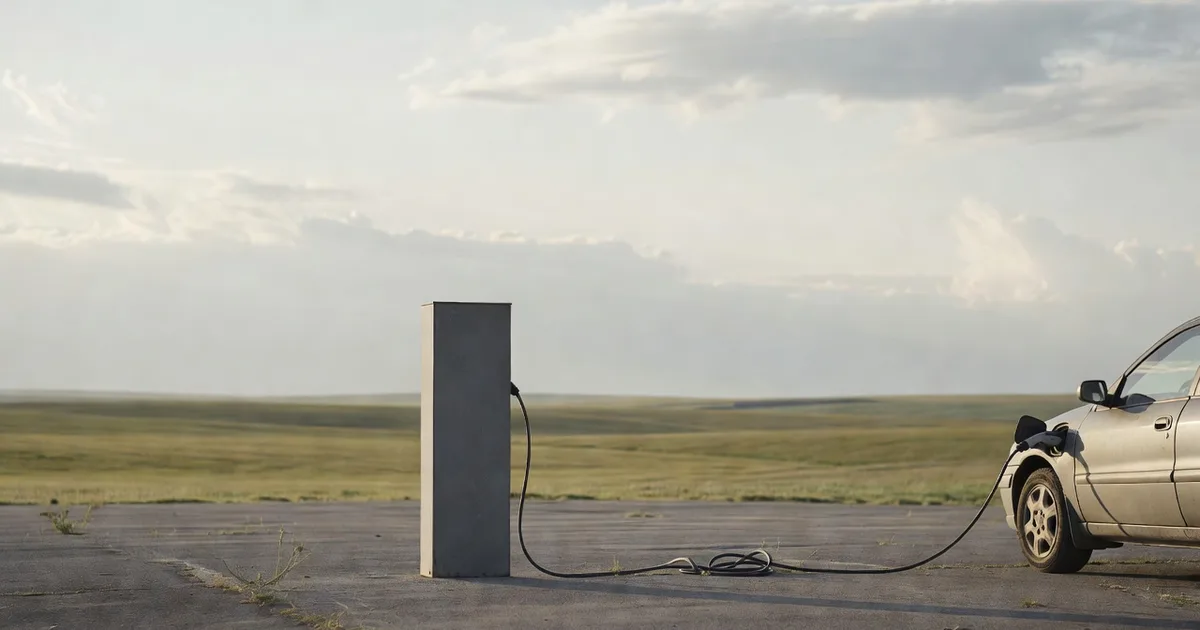
The United States has 76,041 public DC fast-charging plugs at 15,433 locations. Both numbers get quoted; only one of them matters, because 32.3 per cent of those locations have exactly one plug. If it is occupied, or broken, there is nothing else there. And Tesla alone holds 50.4 per cent of every plug in the country from 20.2 per cent of the sites.
Counting locations flatters the map
A charging map shows pins, and a pin is a location. But you do not plug into a location, you plug into one of its stalls, and the distribution of stalls is far more lopsided than the distribution of pins. 4,978 of the 15,433 public fast-charging sites in the country have a single plug; another 2,190 have two. Together that is 46 per cent of the map made of places where one other driver can block you.
At the other end, the 423 sites with seventeen plugs or more are only 2.7 per cent of locations. Those are the ones a long drive is actually planned around, and there are fewer of them than there are counties in most states.
Half the plugs belong to one company
Tesla operates 3,110 sites — 20.2 per cent of the total — and 38,307 plugs, which is 50.4 per cent. It builds 12.3 plugs per location. ChargePoint Network is the mirror image: 4,363 sites, more locations than anyone, and 4,739 plugs — 1.1 per site. On a map they look comparable. On a Friday afternoon they are not.
| Network | Sites | Plugs | Plugs per site | Share of plugs |
|---|---|---|---|---|
| Tesla | 3,110 | 38,307 | 12.3 | 50.4% |
| Electrify America | 1,184 | 5,951 | 5.0 | 7.8% |
| eVgo Network | 1,179 | 5,213 | 4.4 | 6.9% |
| ChargePoint Network | 4,363 | 4,739 | 1.1 | 6.2% |
| Red E | 576 | 2,151 | 3.7 | 2.8% |
| Blink Network | 643 | 1,941 | 3.0 | 2.6% |
| EV Connect | 737 | 1,603 | 2.2 | 2.1% |
| IONNA | 175 | 1,488 | 8.5 | 2.0% |
| Ford Charge | 343 | 1,254 | 3.7 | 1.6% |
| RIVIAN_ADVENTURE | 158 | 1,105 | 7.0 | 1.5% |
| Independent sites | 514 | 1,093 | 2.1 | 1.4% |
| WALMART | 110 | 916 | 8.3 | 1.2% |
| EVCS | 221 | 879 | 4.0 | 1.2% |
| BP_PULSE | 91 | 836 | 9.2 | 1.1% |
| FCN | 168 | 780 | 4.6 | 1.0% |
| MERCEDES_BENZ | 80 | 748 | 9.3 | 1.0% |
| EVGATEWAY | 108 | 519 | 4.8 | 0.7% |
| Shell Recharge | 71 | 469 | 6.6 | 0.6% |
| CHARGESMART_EV | 86 | 442 | 5.1 | 0.6% |
| VIALYNK | 103 | 418 | 4.1 | 0.5% |
| All networks | 15,433 | 76,041 | 4.9 | 100% |
This is why “how many charging stations are near me” is the wrong search. Two networks with the same pin count can differ by a factor of ten in how many cars they can serve at once, and the second-largest network by plugs, Electrify America, has barely a third of Tesla’s total.
Every state, and how thin the coverage really is
The five largest states hold 28 per cent of the country’s fast-charging plugs: Alabama, Alaska, Arizona, Arkansas, California. Alabama alone has 891, more than the 6 smallest states put together.
| State | Sites | Plugs | Plugs per site | Single-plug sites | Biggest network |
|---|---|---|---|---|---|
| Alabama | 238 | 891 | 3.7 | 54% | Tesla |
| Alaska | 26 | 100 | 3.8 | 19% | Tesla |
| Arizona | 215 | 1,504 | 7.0 | 22% | Tesla |
| Arkansas | 65 | 287 | 4.4 | 18% | Tesla |
| California | 2,690 | 18,572 | 6.9 | 30% | Tesla |
| Colorado | 498 | 1,687 | 3.4 | 50% | Tesla |
| Connecticut | 193 | 761 | 3.9 | 42% | Tesla |
| Delaware | 56 | 311 | 5.6 | 16% | Tesla |
| District of Columbia | 10 | 61 | 6.1 | 10% | Tesla |
| Florida | 890 | 5,128 | 5.8 | 23% | Tesla |
| Georgia | 539 | 2,281 | 4.2 | 48% | Tesla |
| Hawaii | 47 | 179 | 3.8 | 13% | OpConnect |
| Idaho | 86 | 309 | 3.6 | 31% | Tesla |
| Illinois | 605 | 2,891 | 4.8 | 21% | Tesla |
| Indiana | 213 | 1,012 | 4.8 | 30% | Tesla |
| Iowa | 149 | 577 | 3.9 | 20% | Tesla |
| Kansas | 86 | 382 | 4.4 | 27% | Tesla |
| Kentucky | 114 | 460 | 4.0 | 27% | Tesla |
| Louisiana | 94 | 410 | 4.4 | 33% | Tesla |
| Maine | 136 | 435 | 3.2 | 54% | Tesla |
| Maryland | 356 | 1,527 | 4.3 | 28% | Tesla |
| Massachusetts | 527 | 1,971 | 3.7 | 41% | Tesla |
| Michigan | 558 | 1,746 | 3.1 | 32% | Red E |
| Minnesota | 251 | 914 | 3.6 | 33% | Tesla |
| Mississippi | 99 | 345 | 3.5 | 45% | Tesla |
| Missouri | 224 | 893 | 4.0 | 35% | Tesla |
| Montana | 55 | 258 | 4.7 | 24% | Tesla |
| Nebraska | 93 | 282 | 3.0 | 52% | Tesla |
| Nevada | 141 | 1,174 | 8.3 | 16% | Tesla |
| New Hampshire | 81 | 346 | 4.3 | 40% | Tesla |
| New Jersey | 412 | 2,114 | 5.1 | 33% | Tesla |
| New Mexico | 177 | 611 | 3.5 | 38% | Tesla |
| New York | 759 | 3,415 | 4.5 | 27% | Tesla |
| North Carolina | 362 | 1,888 | 5.2 | 29% | Tesla |
| North Dakota | 43 | 143 | 3.3 | 40% | Tesla |
| Ohio | 428 | 1,535 | 3.6 | 44% | Tesla |
| Oklahoma | 189 | 897 | 4.7 | 20% | FCN |
| Oregon | 337 | 1,319 | 3.9 | 49% | Tesla |
| Pennsylvania | 425 | 2,020 | 4.8 | 26% | Tesla |
| Rhode Island | 48 | 146 | 3.0 | 42% | Tesla |
| South Carolina | 203 | 938 | 4.6 | 44% | Tesla |
| South Dakota | 46 | 157 | 3.4 | 39% | Tesla |
| Tennessee | 247 | 1,024 | 4.1 | 50% | Tesla |
| Texas | 883 | 5,374 | 6.1 | 22% | Tesla |
| Utah | 194 | 1,009 | 5.2 | 31% | Tesla |
| Vermont | 106 | 319 | 3.0 | 39% | Tesla |
| Virginia | 369 | 1,826 | 4.9 | 23% | Tesla |
| Washington | 529 | 2,315 | 4.4 | 33% | Tesla |
| West Virginia | 56 | 217 | 3.9 | 34% | Tesla |
| Wisconsin | 239 | 910 | 3.8 | 30% | Tesla |
| Wyoming | 45 | 169 | 3.8 | 24% | Tesla |
| Puerto Rico | 1 | 1 | 1.0 | 100% | CHARGELAB |
The single-plug column is the one worth reading before a trip. It runs from under a fifth of sites in the best-covered states to more than half in several, and a state can look respectable on site count while most of those sites are a solitary stall behind a supermarket.
Check your own state
Plugs, sites, rank, and the share of locations with only one stall — plus a comparison against anywhere else.
Your state
Plugs, not sites, is the number that decides whether you wait. Counts are public DC fast charging only, read 2026-09-16 from the US Department of Energy.
What this means for a long drive
On a 500-mile route every EPA-rated car on this site stops twice, and those stops cost between 34 and 96 minutes depending on the car — the full working is in how many charging stops a 500-mile drive takes. This page is the other half of that question. The car decides how long a stop takes; the map decides whether the stop exists, and whether a stall is free when you arrive.
Two practical consequences. A single-plug site is not a charging stop you can plan around, it is one you can hope for. And a car that charges quickly is worth more in a thin state than a thick one, because the queue behind you is shorter and your own stall is freed sooner — the ranking is in the fastest-charging electric cars.
What these numbers do not include
Level 2 charging, which is the overwhelming majority of the country’s 15,433-plus public charge points and is useful for parking rather than travelling. Nor does the count say anything about whether a plug works: AFDC records what operators report, and independent testing has consistently found a gap between listed and functioning. Treat every figure here as the optimistic case.
It also excludes 225 fleet and private facilities, which appear in the raw database but are not available to a passing driver. Puerto Rico is listed in the table but left out of any “fifty states” arithmetic.
Nor does it say which plug is on the cable. Which sites carry NACS, CCS1 or CHAdeMO — and how those families differ in size — is counted separately in EV plug types in the US.
Frequently asked questions
How many EV fast chargers are there in the US?
76,041 public DC fast-charging plugs across 15,433 locations, as recorded by the US Department of Energy on 2026-09-16. The plug count is the meaningful one: a third of those locations have only a single plug.
Which state has the most fast chargers?
Alabama, with 891 plugs at 238 sites — 1.2 per cent of the national total. Alaska is second with 100.
Which charging network is biggest?
Tesla by a wide margin: 38,307 plugs, 50.4 per cent of the national total, at an average of 12.3 plugs per site. Electrify America is second with 5,951.
Why do charging maps look better than reality?
Because a map shows locations and you charge at stalls. 32.3 per cent of US fast-charging locations have one plug and 46 per cent have two or fewer, so the pin density overstates how many cars the network can actually serve at once.
Is a state with few chargers a problem for an EV?
For daily driving, rarely — most charging happens at home, and what that costs is in charging cost by state. For long drives it matters, and it matters more if your car charges slowly, because a thin network punishes a long stop twice: once for you, once for whoever is waiting.
Sources
Station and plug counts: US Department of Energy — Alternative Fuels Data Center, alternative fuel station locator, retrieved 2026-09-16 through its public station-locator service. Filtered to electric, United States, DC fast charging, status available, and public access; 225 private and fleet facilities were removed. Site and plug totals, the per-site distribution, network shares and state figures are our own aggregation of that download; the underlying records are the operators’ own submissions to the Department of Energy.