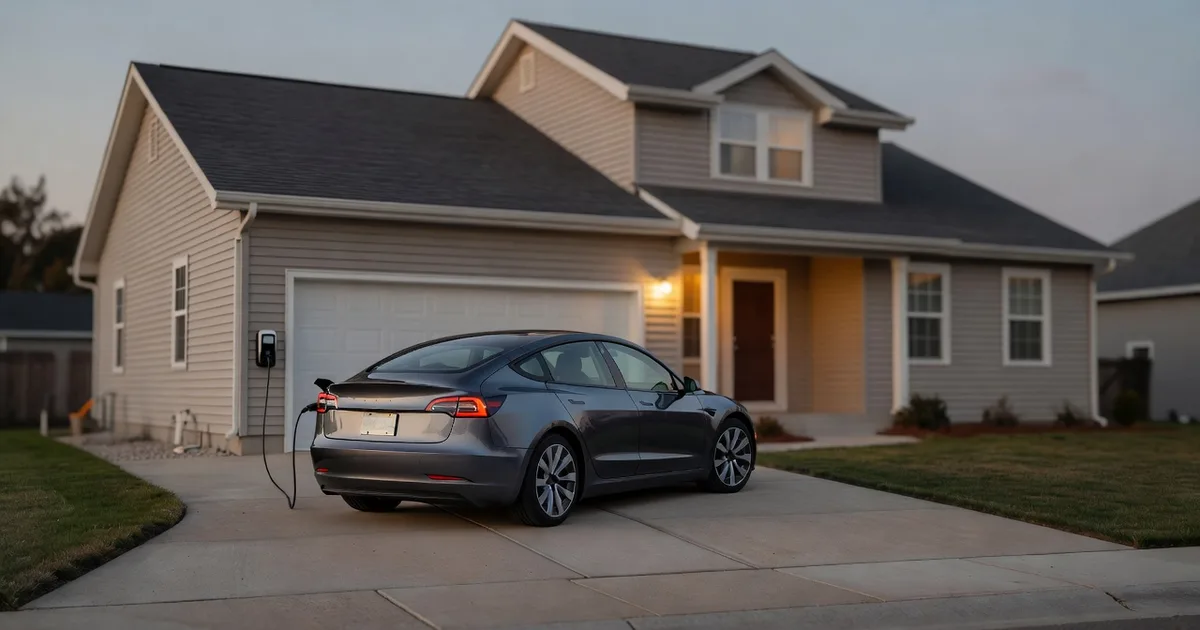
The same electric car costs $44 a month to charge at home in Nevada and $177 in Hawaii — a 4.0-fold difference for identical miles. Where you plug in matters more than which car you buy, and in one state it is enough to hand the win back to petrol.
Every state, cheapest first
The car in this table is the Volkswagen ID.4 Pro, the median of the 15 cars here with an EPA rating: 29.8 kWh per 100 miles, measured at the wall, charging losses included. The month is 1,125 miles — the US average of 13,500 a year divided by twelve. The price of electricity is the EIA’s published residential average for each state, June 2026. The petrol comparison is a 27 mpg car at $4.07 a gallon, $170 a month, the same assumption used in the running-cost calculator.
| State | Cents / kWh | Per 100 miles | Per month | Saved vs petrol |
|---|---|---|---|---|
| Nevada | 13.11 | $3.91 | $44 | $126 |
| Nebraska | 13.25 | $3.95 | $44 | $125 |
| Utah | 13.37 | $3.98 | $45 | $125 |
| Louisiana | 13.49 | $4.02 | $45 | $124 |
| Tennessee | 14.07 | $4.19 | $47 | $122 |
| North Dakota | 14.12 | $4.21 | $47 | $122 |
| Arkansas | 14.12 | $4.21 | $47 | $122 |
| Kentucky | 14.26 | $4.25 | $48 | $122 |
| Oklahoma | 14.33 | $4.27 | $48 | $122 |
| Idaho | 14.37 | $4.28 | $48 | $121 |
| North Carolina | 14.74 | $4.39 | $49 | $120 |
| Mississippi | 14.88 | $4.43 | $50 | $120 |
| Washington | 14.91 | $4.44 | $50 | $120 |
| New Mexico | 15.06 | $4.49 | $50 | $119 |
| Florida | 15.10 | $4.50 | $51 | $119 |
| Montana | 15.14 | $4.51 | $51 | $119 |
| Arizona | 15.18 | $4.52 | $51 | $119 |
| Wyoming | 15.24 | $4.54 | $51 | $118 |
| South Dakota | 15.36 | $4.58 | $51 | $118 |
| West Virginia | 15.45 | $4.60 | $52 | $118 |
| South Carolina | 15.55 | $4.63 | $52 | $117 |
| Kansas | 15.71 | $4.68 | $53 | $117 |
| Iowa | 15.93 | $4.75 | $53 | $116 |
| Texas | 15.94 | $4.75 | $53 | $116 |
| Missouri | 16.22 | $4.83 | $54 | $115 |
| Oregon | 16.32 | $4.86 | $55 | $115 |
| Georgia | 16.36 | $4.88 | $55 | $115 |
| Alabama | 16.40 | $4.89 | $55 | $115 |
| Colorado | 17.13 | $5.10 | $57 | $112 |
| Virginia | 17.22 | $5.13 | $58 | $112 |
| Indiana | 17.51 | $5.22 | $59 | $111 |
| Minnesota | 17.52 | $5.22 | $59 | $111 |
| Ohio | 19.19 | $5.72 | $64 | $105 |
| Delaware | 19.29 | $5.75 | $65 | $105 |
| Wisconsin | 19.56 | $5.83 | $66 | $104 |
| Illinois | 19.89 | $5.93 | $67 | $103 |
| Pennsylvania | 21.73 | $6.48 | $73 | $97 |
| Maryland | 21.84 | $6.51 | $73 | $96 |
| Michigan | 22.99 | $6.85 | $77 | $93 |
| Connecticut | 24.32 | $7.25 | $82 | $88 |
| District of Columbia | 24.39 | $7.27 | $82 | $88 |
| Vermont | 24.44 | $7.28 | $82 | $88 |
| New Jersey | 24.95 | $7.44 | $84 | $86 |
| New Hampshire | 27.01 | $8.05 | $91 | $79 |
| Alaska | 28.21 | $8.41 | $95 | $75 |
| Rhode Island | 29.23 | $8.71 | $98 | $72 |
| New York | 29.49 | $8.79 | $99 | $71 |
| Maine | 29.59 | $8.82 | $99 | $70 |
| Massachusetts | 29.61 | $8.82 | $99 | $70 |
| California | 34.74 | $10.35 | $116 | $53 |
| Hawaii | 52.72 | $15.71 | $177 | −$7 |
| US average | 18.34 | $5.47 | $61 | $108 |
These are residential rates, so they describe charging at home overnight. They are averages across every household in the state and across the whole month: a time-of-use tariff with an overnight window will beat them, and a summer peak will not. What they are good for is comparing one state against another, which is the question this page exists to answer.
The state you live in outweighs the car you choose
Across the 15 cars here, the difference between the most and least efficient is $35 a month at the national average rate — the Rivian R1T Dual Motor, Large pack against the Hyundai Ioniq 6 Long Range RWD. Across the states, the same car swings $133 a month. The geography is 3.8 times the size of the engineering.
It also decides the argument against petrol. At $4.07 a gallon and 27 mpg, the median electric car stops being cheaper to fuel once electricity passes about 51 cents per kilowatt-hour. Only Hawaii is above that line, at 52.72 cents — which is why a national “electric cars are cheaper to run” figure is true almost everywhere and still worth checking where you actually live. The fuel bill is only part of the comparison, though: EV against petrol on total cost adds the purchase price, the depreciation and the year the two cross over.
Every car, in the five biggest electric-car states
Same arithmetic, one row per car. The US average column is the figure that appears in what it costs to charge an electric car per month; the state columns are the same calculation at each state’s published rate.
| Car | EPA kWh / 100 mi | US average | California | Texas | Florida | New York | Washington |
|---|---|---|---|---|---|---|---|
| Hyundai Ioniq 6 Long Range RWD | 26.0 | $54 | $102 | $47 | $44 | $86 | $44 |
| Tesla Model 3 Long Range AWD | 26.4 | $54 | $103 | $47 | $45 | $88 | $44 |
| Tesla Model Y Long Range AWD | 27.5 | $57 | $107 | $49 | $47 | $91 | $46 |
| Toyota bZ4X AWD 73.1 kWh | 28.0 | $58 | $109 | $50 | $48 | $93 | $47 |
| BMW i4 eDrive40 | 28.5 | $59 | $111 | $51 | $48 | $95 | $48 |
| Volvo EX30 Single Motor Extended Range | 29.2 | $60 | $114 | $52 | $50 | $97 | $49 |
| Kia EV6 84 kWh RWD | 29.6 | $61 | $116 | $53 | $50 | $98 | $50 |
| Volkswagen ID.4 Pro | 29.8 | $61 | $116 | $53 | $51 | $99 | $50 |
| Hyundai Ioniq 5 84 kWh RWD | 30.0 | $62 | $117 | $54 | $51 | $100 | $50 |
| Ford Mustang Mach-E Extended Range RWD | 30.7 | $63 | $120 | $55 | $52 | $102 | $51 |
| Ford Mustang Mach-E Standard Range RWD | 31.4 | $65 | $123 | $56 | $53 | $104 | $53 |
| Nissan Ariya e-4ORCE 87 kWh | 36.6 | $76 | $143 | $66 | $62 | $121 | $61 |
| Porsche Taycan (rear-wheel drive) | 37.1 | $77 | $145 | $67 | $63 | $123 | $62 |
| Kia EV9 99.8 kWh AWD | 40.0 | $83 | $156 | $72 | $68 | $133 | $67 |
| Rivian R1T Dual Motor, Large pack | 42.9 | $89 | $168 | $77 | $73 | $142 | $72 |
| A 27 mpg petrol car at $4.07 a gallon | — | $170 | $170 | $170 | $170 | $170 | $170 |
The ordering never changes from state to state, because efficiency is a property of the car and the rate is a multiplier applied to all of them equally. What changes is how much the choice is worth: picking the most efficient car over the least saves about $66 a month in California and about $28 a month in Washington.
Public charging does not follow these rates
A DC fast-charging network sets one price across a region and prices its hardware and its demand charges into it, so it does not track the residential rate at all. A typical public DC rate of $0.48 per kWh is roughly 2.6 times the national residential average, and in Nevada it is 3.7 times the local one. That gap, not the state you live in, is why a car that is cheap to run at home can cost more than petrol on a road trip — the working is in what actually decides charging speed and on each car’s charging page.
The rankings on this site cover the cars we document in full. If you want the whole US market instead — every electric car the EPA has certified, 403 models, searchable and sortable — that is the electric car range comparison. It is EPA range and consumption only, and it says so.
Frequently asked questions
Which state is cheapest to charge an electric car?
Nevada, at 13.11 cents per kilowatt-hour — $44 a month for the median car in this database. Nebraska and Utah are within a third of a cent of it.
Which state is most expensive?
Hawaii, at 52.72 cents — $177 a month for the same car, and the only state where charging it at home costs more than fuelling a 27 mpg petrol car. California is next at 34.74 cents, and it is not close.
How much does it cost to charge an EV in California?
At 34.74 cents per kilowatt-hour, $10.80 per 100 miles for the median car — about $122 a month at 1,125 miles, against $170 in petrol. The most efficient car here, the Lucid Air Pure RWD, costs $90.
Do these figures include charging losses?
Yes. The EPA’s kilowatt-hours per 100 miles is measured at the wall socket, not at the battery, so the energy lost as heat in the charger and the cable is already inside the number. A figure worked out from battery capacity and range instead would understate the bill by roughly a tenth.
Are these rates what I will actually pay?
They are the state-wide residential average for June 2026, so they are the right basis for comparing states and the wrong basis for predicting your bill. Your utility, your tariff and the hour you charge all move the number. Put your own rate into the running-cost calculator for a figure that applies to you.
Your state, on its own page
Each state has a page with the same arithmetic for all 15 EPA-rated cars, its public fast-charging plug count, the number of electric cars registered there and a comparison with the states it borders. The figure after each name is the monthly home-charging cost for the median car.
- Alabama $55/mo
- Alaska $95/mo
- Arizona $51/mo
- Arkansas $47/mo
- California $116/mo
- Colorado $57/mo
- Connecticut $82/mo
- Delaware $65/mo
- Florida $51/mo
- Georgia $55/mo
- Hawaii $177/mo
- Idaho $48/mo
- Illinois $67/mo
- Indiana $59/mo
- Iowa $53/mo
- Kansas $53/mo
- Kentucky $48/mo
- Louisiana $45/mo
- Maine $99/mo
- Maryland $73/mo
- Massachusetts $99/mo
- Michigan $77/mo
- Minnesota $59/mo
- Mississippi $50/mo
- Missouri $54/mo
- Montana $51/mo
- Nebraska $44/mo
- Nevada $44/mo
- New Hampshire $91/mo
- New Jersey $84/mo
- New Mexico $50/mo
- New York $99/mo
- North Carolina $49/mo
- North Dakota $47/mo
- Ohio $64/mo
- Oklahoma $48/mo
- Oregon $55/mo
- Pennsylvania $73/mo
- Rhode Island $98/mo
- South Carolina $52/mo
- South Dakota $51/mo
- Tennessee $47/mo
- Texas $53/mo
- Utah $45/mo
- Vermont $82/mo
- Virginia $58/mo
- Washington $50/mo
- Washington DC $82/mo
- West Virginia $52/mo
- Wisconsin $66/mo
- Wyoming $51/mo
Your state, on its own page
Each state has a page with the same arithmetic for all 15 EPA-rated cars, its public fast-charging plug count, the number of electric cars registered there and a comparison with the states it borders. The figure after each name is the monthly home-charging cost for the median car.
- Alabama $55/mo
- Alaska $95/mo
- Arizona $51/mo
- Arkansas $47/mo
- California $116/mo
- Colorado $57/mo
- Connecticut $82/mo
- Delaware $65/mo
- Florida $51/mo
- Georgia $55/mo
- Hawaii $177/mo
- Idaho $48/mo
- Illinois $67/mo
- Indiana $59/mo
- Iowa $53/mo
- Kansas $53/mo
- Kentucky $48/mo
- Louisiana $45/mo
- Maine $99/mo
- Maryland $73/mo
- Massachusetts $99/mo
- Michigan $77/mo
- Minnesota $59/mo
- Mississippi $50/mo
- Missouri $54/mo
- Montana $51/mo
- Nebraska $44/mo
- Nevada $44/mo
- New Hampshire $91/mo
- New Jersey $84/mo
- New Mexico $50/mo
- New York $99/mo
- North Carolina $49/mo
- North Dakota $47/mo
- Ohio $64/mo
- Oklahoma $48/mo
- Oregon $55/mo
- Pennsylvania $73/mo
- Rhode Island $98/mo
- South Carolina $52/mo
- South Dakota $51/mo
- Tennessee $47/mo
- Texas $53/mo
- Utah $45/mo
- Vermont $82/mo
- Virginia $58/mo
- Washington $50/mo
- Washington DC $82/mo
- West Virginia $52/mo
- Wisconsin $66/mo
- Wyoming $51/mo
Sources
Electricity prices: US Energy Information Administration — Electric Power Monthly, Table 5.6.A, average price of electricity to ultimate customers, residential sector, June 2026, read 2026-09. Energy use per 100 miles: each car’s EPA combined rating from fueleconomy.gov, credited with its model year on the car’s own page. Mileage, petrol price and the public DC rate are the standing assumptions set out on the methodology page. Monthly figures are the per-100-mile cost multiplied by 11.25 and rounded to the dollar; the per-100-mile column is not rounded before that multiplication.