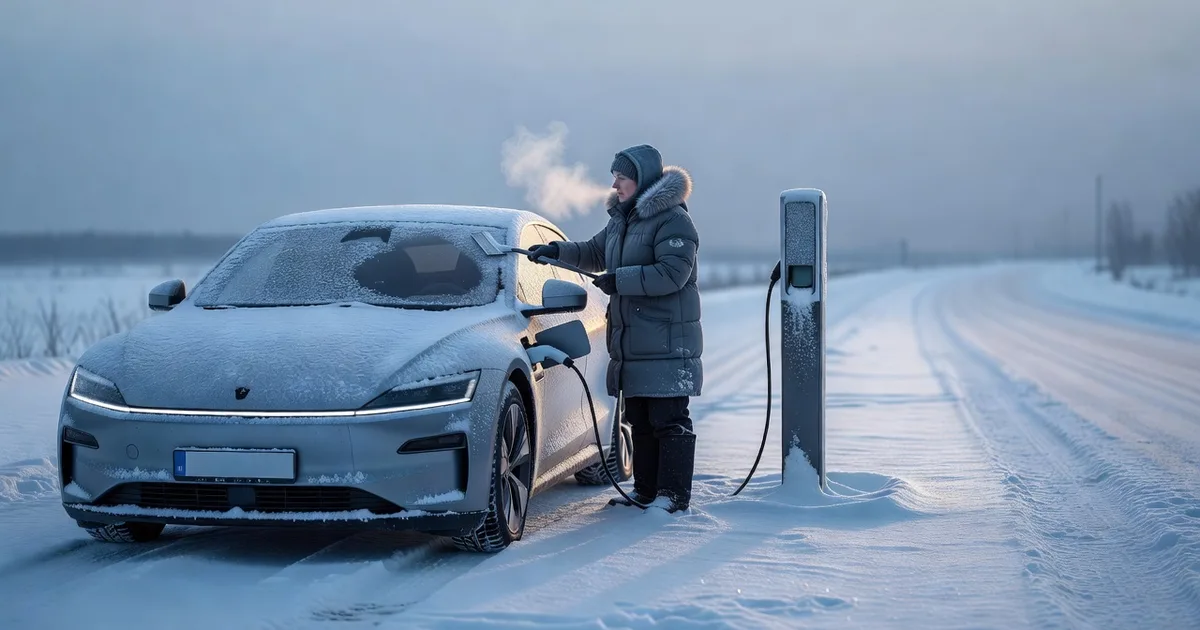
Yes, electric cars lose range in the cold, and the reason is mostly not the one people assume. The battery itself gives up some capacity below freezing, but the larger share of the loss goes to heating the cabin — because unlike a petrol car, an electric car has no waste engine heat to use and has to make warmth out of range.
Where the range actually goes
Three separate effects stack up, and they are worth separating because only two of them are avoidable.
1. Cabin heat. A resistive heater pulling 3–5 kW to warm a cold car is drawing the equivalent of driving 20–30 km/h worth of energy while stationary. On a short winter trip this can be the single largest consumer — which is why a ten-minute school run in January is the worst efficiency you will ever see.
A heat pump moves heat from outside air rather than generating it, delivering two to three times the warmth per kilowatt-hour. It is the single most valuable cold-weather option on any electric car and it stops helping much below roughly –10 °C, where most systems fall back to resistive heating.
2. Battery chemistry slows down. Lithium ions move less freely through a cold electrolyte, so internal resistance rises, less energy is usable, and the pack accepts charge more slowly. This part is physics, not a design flaw, and it recovers completely as the pack warms.
3. Everything else gets harder. Cold air is denser, so aerodynamic drag rises. Tyres are stiffer and roll less freely. Snow and slush add resistance. Winter tyres are less efficient than summer ones.
Chemistry changes how much you lose
This is the part most cold-weather articles miss. Lithium iron phosphate — LFP — loses more capacity in the cold than nickel-based chemistries, and accepts charge more slowly when cold. It is otherwise the more durable and more thermally stable chemistry, and cheaper, which is exactly the sort of genuine trade-off a spec sheet never shows you.
If you live somewhere with real winters and depend on rapid charging, that is the trade to think hardest about. Our LFP list shows which cars use it, and the LFP reference page carries the figures with their sources.
Sodium-ion is the interesting exception, and the reason we track it. Published figures put it above 90 per cent capacity retention at −40 °C — far better than any lithium chemistry in production. It is in cars now, at lower energy density, and the details are on our sodium-ion page.
Cold hits charging harder than it hits range
A cold pack will not accept high power, and the car is right to refuse — forcing current into cold cells plates lithium metal onto the anode and causes permanent damage. So the battery management system limits charging until the pack warms, which on a very cold day can double a rapid-charge time or worse.
This is why pre-conditioning is the most valuable winter feature on an electric car. Cars that warm the pack automatically when you navigate to a charger arrive ready to take full power; cars that do not, or that hide the function three menus deep, do not. It appears in no specification table, including ours, and on a winter journey it matters more than most of the numbers that do.
Our published 10–80 per cent times all assume a pack at a sensible temperature — see the charging ranking for what those figures do and do not cover.
What the official figures include
Almost nothing, in the European case. WLTP tests at 23 °C, so a WLTP range figure describes a mild spring day and nothing else. The EPA procedure includes a cycle at −7 °C, which is part of why EPA figures land far closer to real-world results — we measured observed range at about 92 per cent of EPA against 79 per cent of WLTP across our database, and wrote that up in EPA vs WLTP range.
The observed figures on this site are mixed-conditions numbers. They are not winter numbers. Expect to be below them in January, and expect our claimed vs real range ranking to understate the gap in cold weather.
Six things that actually help
- Pre-heat on the cable. Warm the cabin and the pack while still plugged in and the energy comes from the wall, not the battery. This is the single biggest win available and it costs nothing.
- Use the seat and wheel heaters instead of the cabin. A heated seat draws tens of watts; heating the air draws thousands.
- Pre-condition before a rapid charge. If your car does not do it automatically, find the manual control and use it.
- Specify the heat pump. Where it is optional, it is usually the best-value option on the list for anyone in a cold climate.
- Park somewhere sheltered. A garage a few degrees above the street means a warmer pack before you start.
- Slow down. Drag rises with the square of speed and cold air is denser. 110 km/h instead of 130 buys back a surprising amount.
Frequently asked questions
How much range does an electric car lose in winter?
It depends far more on your journey than on your car. A long steady motorway run in the cold might cost 10–20 per cent; a series of short trips from cold, with the heater working hard each time, can cost a great deal more because the cabin never stops being heated and the pack never gets warm. We do not publish a single figure because a single figure would be misleading.
Does cold damage the battery permanently?
Simply being cold does not — the capacity comes back as the pack warms. What does cause permanent damage is charging a cold pack at high power, which is precisely why the car limits it. Let it protect itself.
Is a heat pump worth the money?
In a cold climate, almost always. It delivers two to three times the heat per kilowatt-hour of a resistive heater across the temperature range where most winter driving happens. Below about −10 °C the advantage narrows considerably.
Should I avoid an LFP car if I live somewhere cold?
Not necessarily — but know the trade. LFP loses more in the cold and charges more slowly when cold, while being more durable, more thermally stable and cheaper. If you charge at home and drive moderate distances the cold penalty matters little; if you rely on winter rapid charging it matters a lot.
Sources
- US EPA / fueleconomy.gov — test procedure including the cold-temperature cycle
- Chemistry cold-weather behaviour and the sodium-ion figures, with their individual sources: our LFP, NMC and sodium-ion reference pages.
- Observed against official range across nineteen cars: computed from this site’s database, September 2026 — see EPA vs WLTP range.