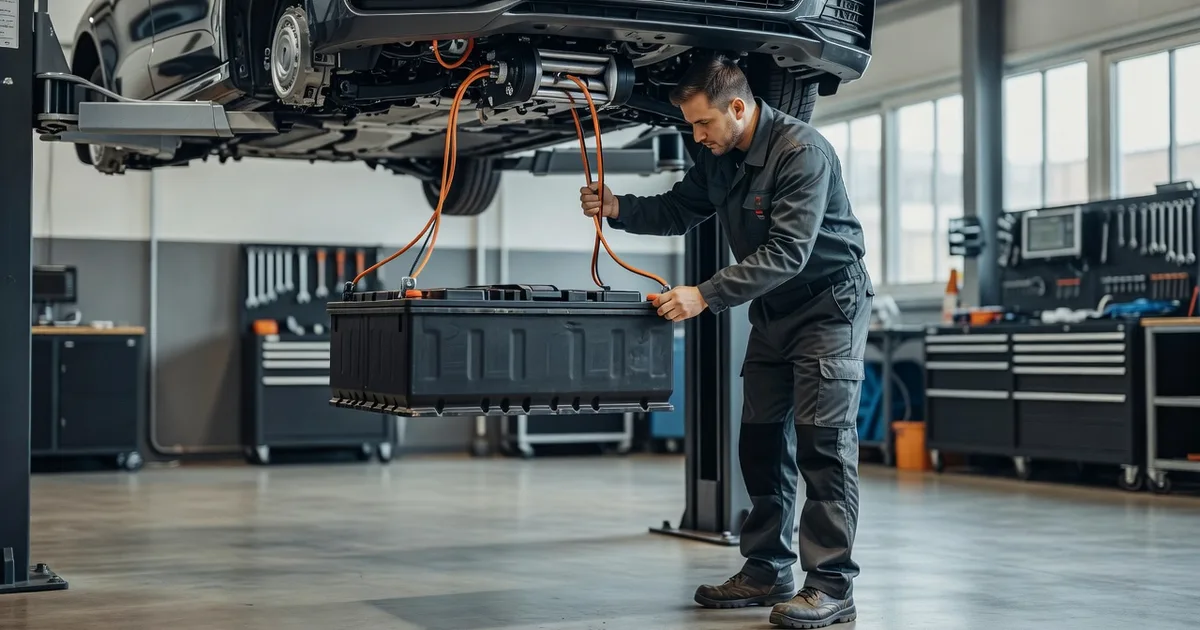
Battery replacement is the fear that keeps people out of electric cars, and the honest answer is uncomfortable in both directions: a pack replacement is genuinely expensive — roughly $10,700 to $15,800 across the cars on this site — and it is also something most owners will never pay for, because the warranty outlasts the risk and packs are not failing at the rate the fear assumes.
What our figures actually are
Every vehicle page on this site carries an out-of-warranty pack replacement figure. It is an estimate, it is labelled as one everywhere it appears, and it is not a quotation. Nobody publishes a price list for pack replacement — dealers quote per case, quotes vary by market and by workshop, and the number changes every year as cell prices fall.
So we calculate it, and publish the calculation. It is usable capacity multiplied by an installed cost per kilowatt-hour, currently about $165 or €150 per kWh — a pack price plus the labour, coolant, ancillaries and margin that turn a pack into a repaired car. The full working is on the methodology page.
| Car | Usable capacity | Estimated replacement |
|---|---|---|
| Volvo EX30 Single Motor ER | 65 kWh | ≈ $10,700 / €9,800 |
| Hyundai Ioniq 6 Long Range RWD | 74 kWh | ≈ $12,200 / €11,100 |
| Tesla Model Y Long Range AWD | 75 kWh | ≈ $12,400 / €11,300 |
| BMW i4 eDrive40 | 81.3 kWh | ≈ $13,400 / €12,200 |
| Ford Mustang Mach-E Extended Range | 91 kWh | ≈ $15,000 / €13,700 |
| Kia EV9 99.8 kWh AWD | 96 kWh | ≈ $15,800 / €14,400 |
Own a Tesla? Tesla publishes no pack price, but it does publish its battery warranty tiers and a $2,000 extension; both, plus the one full Tesla Service invoice we could find, are on the Tesla battery replacement cost and warranty page.
Why the number keeps falling
Cell and pack prices have collapsed over the past decade and continued falling through 2025. BloombergNEF’s annual survey put average pack prices at about $108 per kWh in 2025, with lithium iron phosphate packs near $81 and nickel-manganese-cobalt packs near $128.
Those are manufacturing pack prices, not what a workshop charges you — the gap between $108 and our $165 installed figure is labour, logistics, warranty handling and margin. But the direction matters: an estimate made today for a claim in 2033 is a projection against a falling curve, and it will very likely turn out high.
Chemistry matters too. LFP packs are meaningfully cheaper per kilowatt-hour, which is one reason the LFP cars in our database carry lower replacement estimates for their size. The full figures for each chemistry are on the LFP and NMC reference pages.
The warranty is the real answer
Every car on this site is warranted for eight years, and typically 160,000 km in Europe or 100,000 miles in the United States, with replacement or repair if capacity falls below a stated floor — almost always 70 per cent.
Read that floor carefully, because it cuts both ways. It means you are protected against a pack that fails or degrades abnormally. It also means normal ageing will almost certainly not trigger a claim: published fleet data suggests a typical pack loses in the region of 2 to 2.7 per cent of capacity a year, which over eight years lands somewhere near 78 to 84 per cent — comfortably above the 70 per cent floor.
So the warranty covers the catastrophe, not the gradual decline. We compare the terms across the database on best EV battery warranties.
You probably will not replace the whole pack anyway
The scenario in most people’s heads — the pack dies, you buy a new one — is the least likely outcome and the most expensive one. Three cheaper paths exist and are increasingly common.
Module replacement. Packs are built from modules, and a fault is often confined to one. Manufacturers who design for this can replace a module for a fraction of a full pack.
Independent specialists. A growing repair sector rebuilds and reconditions packs at well below franchised-dealer prices. It is uneven in quality and it exists.
Living with less range. A pack at 75 per cent capacity is not a broken car. If your daily driving fits inside the reduced range — and for most people it does — the rational choice is often to keep driving it.
What we deliberately do not tell you
We do not publish a per-model degradation rate, because nobody has one. The single fleet dataset large enough to be meaningful anonymises the models, no manufacturer releases its own data, and no independent body measures at the necessary scale. Any site presenting a model-by-model degradation table is estimating, and our projections use a published class rate and say so.
We also leave five-year residual values blank on every car. There is no reliable public dataset for electric-car residuals in either market that we are willing to stand behind, and a made-up number in that field would undermine every real one next to it.
Frequently asked questions
How much does it cost to replace an EV battery in 2026?
For the cars on this site, roughly $10,700 to $15,800 installed, driven almost entirely by pack size. These are our own estimates from a published formula, not dealer quotations — a real quote depends on your market, your workshop and whether a module repair is possible.
How long does an EV battery actually last?
Longer than the fear suggests. At 2 to 2.7 per cent capacity loss a year, a pack is still around 80 per cent after eight years and functional well beyond that. Calendar age drives a substantial part of the loss independently of mileage, which is why the rate is published per year rather than per kilometre.
Does rapid charging shorten pack life?
Heavy reliance on it appears to. Cars doing more than about an eighth of their charging on DC above 100 kW degraded faster in the fleet data than cars charged mainly on AC. Occasional rapid charging on a journey is not the concern; making it your only method is.
Does the battery warranty transfer to a used buyer?
Usually yes, for the remainder of the term, and that is a significant part of what supports used electric car values. Confirm it in the specific warranty document rather than assuming — the terms are not identical across manufacturers.
Sources
- BloombergNEF — annual lithium-ion battery price survey, 2025 pack and cell prices by chemistry
- Geotab — EV battery degradation study, class-average annual capacity loss and the effect of DC fast charging
- Replacement estimates and warranty terms per car: the vehicle pages on this site. The estimate formula is published at /methodology/.