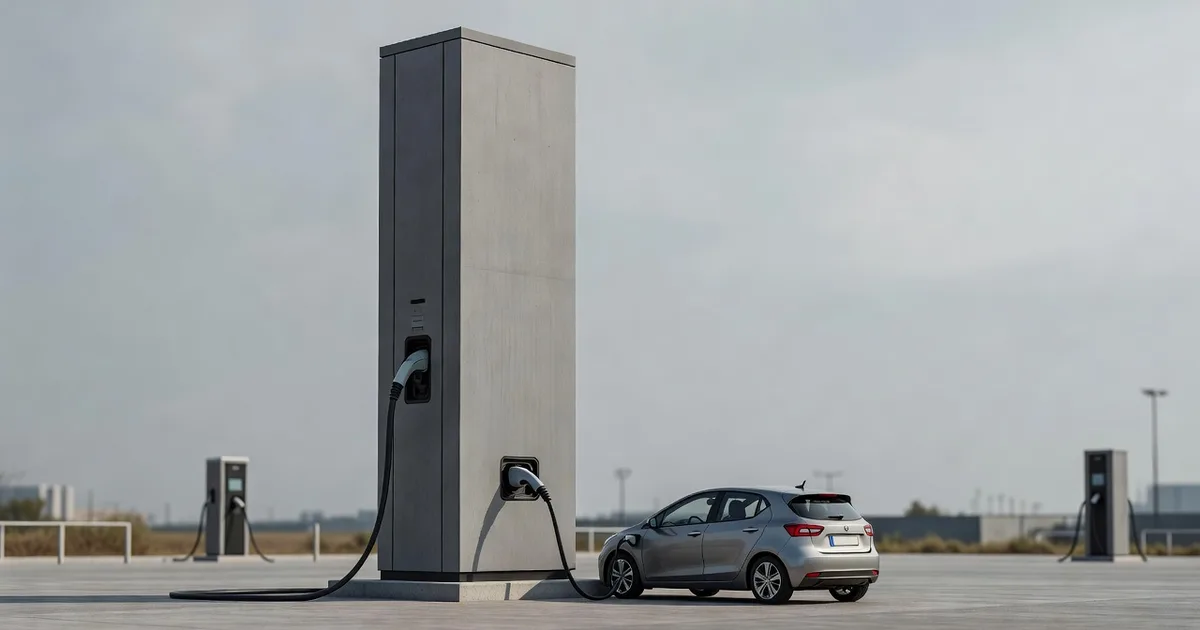
Of the 14 US-rated electric cars on this site with a measured 10-80 per cent charge time, 5 get anything at all from a 350 kW charger. The other 9 reach their own ceiling at 150 kW and cannot use a watt more. The dividing line is not the brand, the price or the number on the spec sheet — it is whether the car runs a 400-volt or an 800-volt pack.
The whole answer, in one table
Both columns are the time to take the battery from 10 to 80 per cent. Where the two are equal, the car — not the charger — is the limit.
| Car | Pack | Peak DC | 10-80% on 150 kW | 10-80% on 350 kW | What 350 kW buys |
|---|---|---|---|---|---|
| Kia EV6 84 kWh RWD | 800 V | 263 kW | 22 min | 17 min | 5 min |
| Kia EV9 99.8 kWh AWD | 800 V | 209 kW | 27 min | 22 min | 5 min |
| Hyundai Ioniq 6 Long Range RWD | 800 V | 233 kW | 21 min | 17 min | 4 min |
| Hyundai Ioniq 5 84 kWh RWD | 800 V | 263 kW | 22 min | 18 min | 4 min |
| Porsche Taycan (rear-wheel drive) | 800 V | 270 kW | 23 min | 19 min | 4 min |
| Tesla Model Y Long Range AWD | 400 V | 250 kW | 27 min | 27 min | nothing |
| Tesla Model 3 Long Range AWD | 400 V | 250 kW | 28 min | 28 min | nothing |
| BMW i4 eDrive40 | 400 V | 205 kW | 28 min | 28 min | nothing |
| Volvo EX30 Single Motor Extended Range | 400 V | 158 kW | 28 min | 28 min | nothing |
| Toyota bZ4X AWD 73.1 kWh | 400 V | 150 kW | 28 min | 28 min | nothing |
| Volkswagen ID.4 Pro | 400 V | 175 kW | 28 min | 28 min | nothing |
| Ford Mustang Mach-E Extended Range RWD | 400 V | 150 kW | 32 min | 32 min | nothing |
| Ford Mustang Mach-E Standard Range RWD | 400 V | 150 kW | 32 min | 32 min | nothing |
| Nissan Ariya e-4ORCE 87 kWh | 400 V | 130 kW | 48 min | 48 min | nothing |
Why 800 volts is the whole story
Charging power is voltage times current. A charging cable can only carry so much current before it has to be actively cooled, so the practical way to push more kilowatts into a car is to raise the voltage rather than the amps. A 400-volt pack drawing 375 amps takes 150 kW. An 800-volt pack drawing the same current takes 300.
That is why every car in the top half of the table runs an 800-volt architecture and every car in the bottom half runs 400. It is not a tuning choice a manufacturer can make later; it is how the battery is wired.
The largest real gain here is the Kia EV6 84 kWh RWD, which saves 5 minutes. The full list of cars built this way is on 800-volt electric cars.
The peak kW figure on the spec sheet does not tell you this
Manufacturers quote a peak DC power, and it is close to meaningless on its own: it is held for a few per cent of the charge and says nothing about the shape of the curve after it. What you actually wait for is the 10 to 80 per cent window, which is why that is the figure this site compares cars on.
The Nissan Ariya e-4ORCE 87 kWh is the clearest case. It is rated 130 kW, but takes 48 minutes for the 10-80 window on any station from 150 kW upward. Plugging it into a 350 kW post changes nothing except which bay you occupy. The reasoning is set out in what a 10-80% charge time tells you.
What this means at the charging stop
If you drive a 400-volt car — which is most electric cars sold today, including both Teslas here — you can ignore the difference between a 150 kW and a 350 kW post entirely. Pick on price, queue length and location. The faster hardware will not charge your car faster.
If you drive an 800-volt car, the difference is four or five minutes a stop. Real, but smaller than the marketing implies, and only available when the station is not sharing its power with the car in the next bay.
The one thing worth avoiding in both cases is the 50 kW post. That is where the times roughly double, and it is the only charger power on this site that changes the answer for every single car. Per-car figures at all three powers are on the charging time and cost pages.
What those minutes add up to over a real drive is the other half of the question: on a 500-mile route every EPA-rated car here stops twice, and the two stops cost anywhere from 34 minutes to 96 depending on which car you are in. The full table is in how many charging stops a 500-mile drive takes.
What each car actually does at a station
The table above is the comparison. Each car also has a page that says what its own curve means at a 50 kW post, a 150 kW one and a 350 kW one, with the cost of each stop.
- Hyundai Ioniq 6 charging time and cost
- Kia EV6 charging time and cost
- Hyundai Ioniq 5 charging time and cost
- Porsche Taycan charging time and cost
- Kia EV9 charging time and cost
- Tesla Model Y charging time and cost
- Volkswagen ID.7 charging time and cost
- BMW i4 charging time and cost
- Tesla Model 3 charging time and cost
- Toyota bZ4X charging time and cost
- Volkswagen ID.4 charging time and cost
- Volvo EX30 charging time and cost
- Ford Mustang Mach-E charging time and cost
- BYD Seal charging time and cost
- Nissan Ariya charging time and cost
Frequently asked questions
Does a 350 kW charger charge my car faster?
Only if your car has an 800-volt battery pack. Of the 14 cars measured here, 5 charge faster on a 350 kW station than on a 150 kW one; the other 9 take exactly the same time on both.
Which electric cars can use 350 kW charging?
The 800-volt cars: Kia EV6 84 kWh RWD, Kia EV9 99.8 kWh AWD, Hyundai Ioniq 6 Long Range RWD, Hyundai Ioniq 5 84 kWh RWD, Porsche Taycan (rear-wheel drive). Every 400-volt car on this site tops out at what a 150 kW station already delivers.
Is it bad to charge a 400-volt car on a 350 kW station?
No. The car and the station negotiate the power, and the car takes only what it can accept. It is not harmful, it is just not faster.
Why does my car never hit its advertised peak power?
The peak is held briefly at a low state of charge and on a preconditioned battery. A cold pack, a battery above roughly 50 per cent, or a station sharing power between bays will all put you below it — which is why the 10-80 window is the honest comparison.
Method and sources
The 10-80 per cent times are measured figures credited on each car’s own page. The 150 kW and 350 kW columns apply the station power to the car’s usable capacity and then floor the result at the car’s measured time, because a car cannot charge faster on a weaker station than on its own peak — an arithmetic trap that a naive constant-power calculation walks straight into. The full working is on the methodology page.