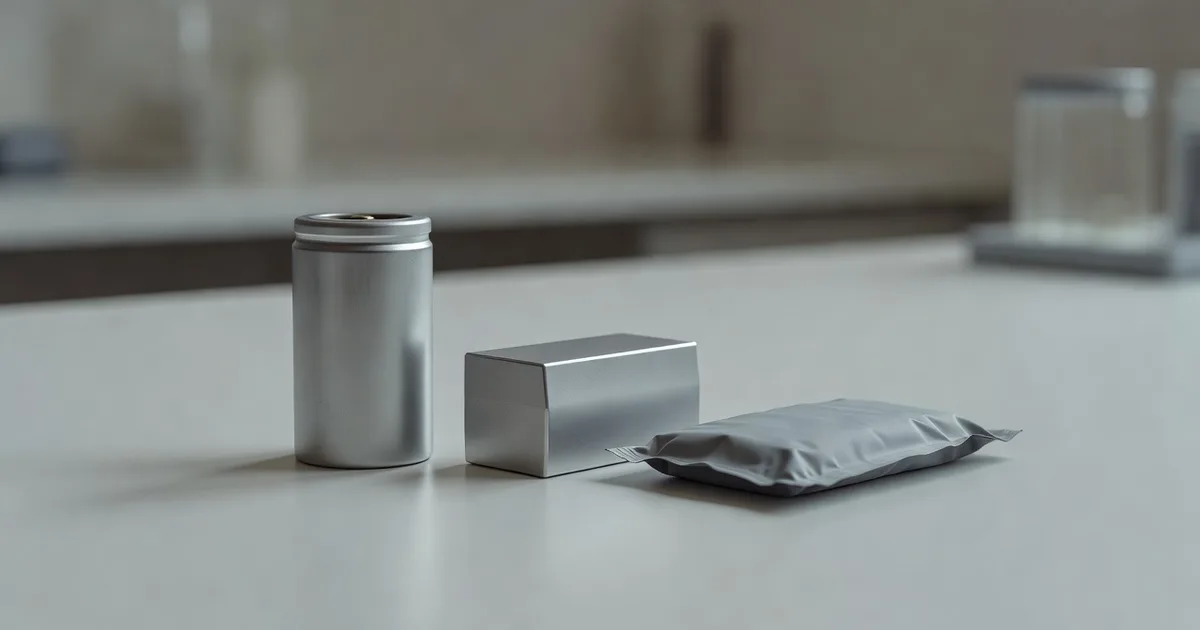
The short answer: if you are buying a car in 2026, the choice is between LFP and a nickel-rich chemistry, and it comes down to how you charge. LFP is safer, cheaper and happy to be charged to 100% every night, but heavier and slower in the cold. NMC and NCA pack more range into less weight and charge faster. Solid-state is real engineering, not vapour, but it is at pilot-line and customer-sample stage — no car you can buy this year has it.
The three chemistries at a glance
| LFP | NMC / NCA | Solid-state | |
|---|---|---|---|
| Energy density | Lower — a heavier pack for the same kWh | Higher — the reason long-range cars use it | Highest demonstrated; ~800–900 Wh/L in prototypes |
| Thermal safety | Best. Runaway starts far hotter and releases less energy | Adequate with active cooling; the reason cooling matters more here | Promising, unproven at scale |
| Daily charging | To 100% without penalty; manufacturers recommend it | 80% for daily use, 100% before a long trip | Expected to be tolerant, not yet demonstrated in service |
| Cold weather | Noticeably worse; slower charging and more range loss | Better, though nothing likes -10°C | Unknown in real use |
| Cost | Cheapest. About $81/kWh at pack level in 2025 | About $128/kWh at pack level | Not in volume production; no meaningful price |
| Available in 2026? | Yes, widely | Yes, in most cars | No. Pilot lines and customer samples only |
Pack prices from BloombergNEF’s 2025 lithium-ion battery price survey, which put the global average at $108/kWh across all applications, $99/kWh for BEV packs, $81/kWh for LFP and $128/kWh for NMC.
LFP: the chemistry that stopped being the budget option
Lithium iron phosphate uses no nickel and no cobalt. For years that made it the cheap choice with mediocre range, fitted to entry-level cars and left out of the flagship. That framing is now out of date, and the reason is that the practical advantages turned out to matter more than the specification sheet suggested.
The 100% charging difference
Nickel-rich cells age faster when held at a high state of charge, which is why the standard advice with an NMC car is to set a daily limit around 80% and only charge fully before a long journey. It works, but it means the car you paid for effectively has 80% of the range you paid for on any given morning.
LFP does not have that problem. Manufacturers using it — BYD among them — actively recommend charging to 100% regularly, partly because the flat voltage curve of LFP means the battery management system needs a full charge occasionally to stay calibrated on its state-of-charge estimate. In daily use you simply plug in and stop thinking about it, and the usable range is the range on the label.
The safety difference is not marketing
Iron-phosphate cells begin thermal runaway at a substantially higher temperature than nickel-rich cells, and when they do, they release less energy and do not shed oxygen in the way a nickel cathode does. This is the single largest input in our own battery safety score, and it is the reason an LFP car with ordinary cooling can outscore a nickel car with excellent cooling.
What it costs you
Weight, cold-weather performance and charging speed. LFP’s lower energy density means a bigger, heavier pack for the same capacity, and weight makes everything else slightly worse. Cold hurts it more than nickel chemistries, both in range and in how fast it will accept a charge. And LFP cars generally charge more slowly: the BYD Seal takes 36 minutes from 10 to 80 percent, against 17 for the Hyundai Ioniq 6 — though the LFP Tesla Model 3 RWD manages 24, so the chemistry sets a tendency, not a rule.
NMC and NCA: still the default for long range
Nickel manganese cobalt and nickel cobalt aluminium are what most of the cars in our comparison tool use, and for a straightforward reason: they store more energy per kilogram, which is what lets a car achieve 500 km of real-world range without weighing three tonnes.
The industry trend within nickel chemistries has been to use less cobalt — expensive, and ethically fraught — and more nickel. NMC 811 (eight parts nickel to one each of manganese and cobalt), used in the Porsche Taycan, is the visible result. More nickel means more energy and slightly less thermal margin, which is why active liquid cooling has become non-negotiable on these cars rather than a premium feature.
If you regularly drive long distances, want the fastest possible charging stops, or need maximum range from a given size of car, nickel chemistry is still the answer in 2026.
Solid-state: where it actually is
Solid-state replaces the liquid electrolyte with a solid one. The promise is higher energy density, faster charging and better safety at the same time, because a solid electrolyte does not burn and permits a lithium-metal anode.
Here is the honest 2026 status, which is considerably less exciting than most coverage suggests:
- QuantumScape has shipped B-sample cells to automotive customers, quoting over 800 Wh/L and 10–80% in under fifteen minutes, and installed a pilot production line in 2025. Qualification samples are expected late in 2026, with vehicle integration targeted for 2028.
- Toyota is building large-scale pilot facilities for sulfide electrolytes with partners, and targets commercialisation around 2027–2028. Nothing is in a mass-produced Toyota today.
- Samsung SDI has demonstrated prototypes at around 900 Wh/L and runs a sulfide pilot line, targeting limited production around 2027 — premium vehicles first.
- CATL, the largest cell maker in the world, has been notably quiet, with semi-solid and sulfide roadmaps pointed at the late 2020s.
The defining feature of 2026 is pilot-scale manufacturing: the step where you find out whether a cell that works in a laboratory can be made ten million times at a cost anyone will pay. That is genuine progress and it is also exactly the stage at which battery technologies have historically stalled for years.
What this means for a purchase decision: nothing. There is no solid-state car to wait for in 2026, and if the current timelines hold, the first ones will be low-volume and expensive. Buy the car that suits you now.
Common mistakes
- Treating chemistry as a proxy for quality. A well-engineered LFP pack beats a poorly cooled nickel one on almost every measure that matters. Chemistry is one input among several; thermal management is at least as important.
- Waiting for solid-state. It has been two to three years away for roughly a decade. Buying is a decision about the next five years, not the next fifteen.
- Assuming LFP is the budget option. It is now used in mid-range and performance cars specifically for its durability, not to save money.
- Ignoring the climate you live in. LFP’s cold-weather penalty is real. In Norway it is a meaningful downside; in Spain it barely registers.
- Reading energy density as range. Range is capacity divided by consumption. The Ioniq 6 gets further on 74 kWh than the Kia EV9 does on 96, because efficiency does more work than chemistry ever will.
Practical guidance
- Charge at home, drive moderate distances, live somewhere mild: LFP. The 100% charging habit alone makes ownership simpler.
- Long motorway journeys, cold winters, or a lot of public rapid charging: nickel chemistry with an 800-volt architecture. Charging speed compounds across every stop.
- Either way, check the thermal management row. Active liquid or direct-refrigerant cooling is the strongest predictor of a pack that ages slowly and charges repeatably.
- Compare the cars, not the chemistries. Our comparison tool puts chemistry, cooling, charging speed and observed range in one table.
Frequently asked questions
Is LFP really safe to charge to 100% every day?
Yes, and manufacturers using it recommend it. The flat voltage curve of LFP makes state-of-charge estimation harder, and a periodic full charge is what recalibrates the battery management system. This is the opposite of the advice for nickel chemistries.
Does LFP last longer than NMC?
LFP generally tolerates more full charge cycles in laboratory testing. In real-world fleet data the picture is muddier, because usage patterns matter more than chemistry — vehicles doing most of their charging on high-power DC degrade at roughly double the rate of those charged mainly on AC, whatever is in the cells. Our degradation analysis goes through that data.
Will a solid-state battery be retrofittable to my current car?
No. Pack geometry, voltage, cooling and battery management are all designed around a specific cell. Retrofitting a fundamentally different chemistry is not a service any manufacturer offers or is likely to.
Which chemistry is cheaper to replace out of warranty?
LFP, by a clear margin at cell level — roughly $81/kWh against $128/kWh for NMC in BloombergNEF’s 2025 survey. Installed replacement cost is dominated by labour and dealer margin as well, so the gap narrows in practice. Each vehicle page here carries an estimated replacement cost with the formula published.
What about sodium-ion?
Sodium-ion is genuinely closer to production than solid-state and shares LFP’s thermal stability with better cold-weather behaviour, but lower energy density again. Its likely first home is stationary storage and small city cars rather than long-range vehicles.
Reference pages for each chemistry
This article compares the chemistries against each other. Each one also has its own reference page with the full figures, the sources behind them, and the cars in our database that use it.
- LFP (lithium iron phosphate) — cheapest, longest-cycling, charge it to 100%
- NMC (nickel manganese cobalt) — the long-range default, and what the 811 in NMC 811 means
- NCA (nickel cobalt aluminium) — Panasonic and Tesla’s chemistry, and why build plant decides what is in your car
- Solid-state — where each programme actually is, with stated dates
- Sodium-ion — the emerging chemistry that shipped, and why it wins at −40 °C
Sources
- BloombergNEF, 2025 Lithium-Ion Battery Price Survey — pack prices by chemistry and application
- Geotab, EV battery health study 2026 — degradation by charging behaviour across 22,700 vehicles
- QuantumScape investor filings and 2026 reporting on pilot-line status and sample timelines
- Published 2026 solid-state programme timelines for Toyota, Samsung SDI and CATL
- EV Database — per-model chemistry, charging and range figures cited on each vehicle page